Why Clinicians Need a New Way to Study in the Age of AI. Introducing ReviewBytes
Read more

Readiness systems treat exams and transitions as measurable performance problems—not just knowledge gaps. Learn the Competence × Context × Calibration model for high-stakes medical training.

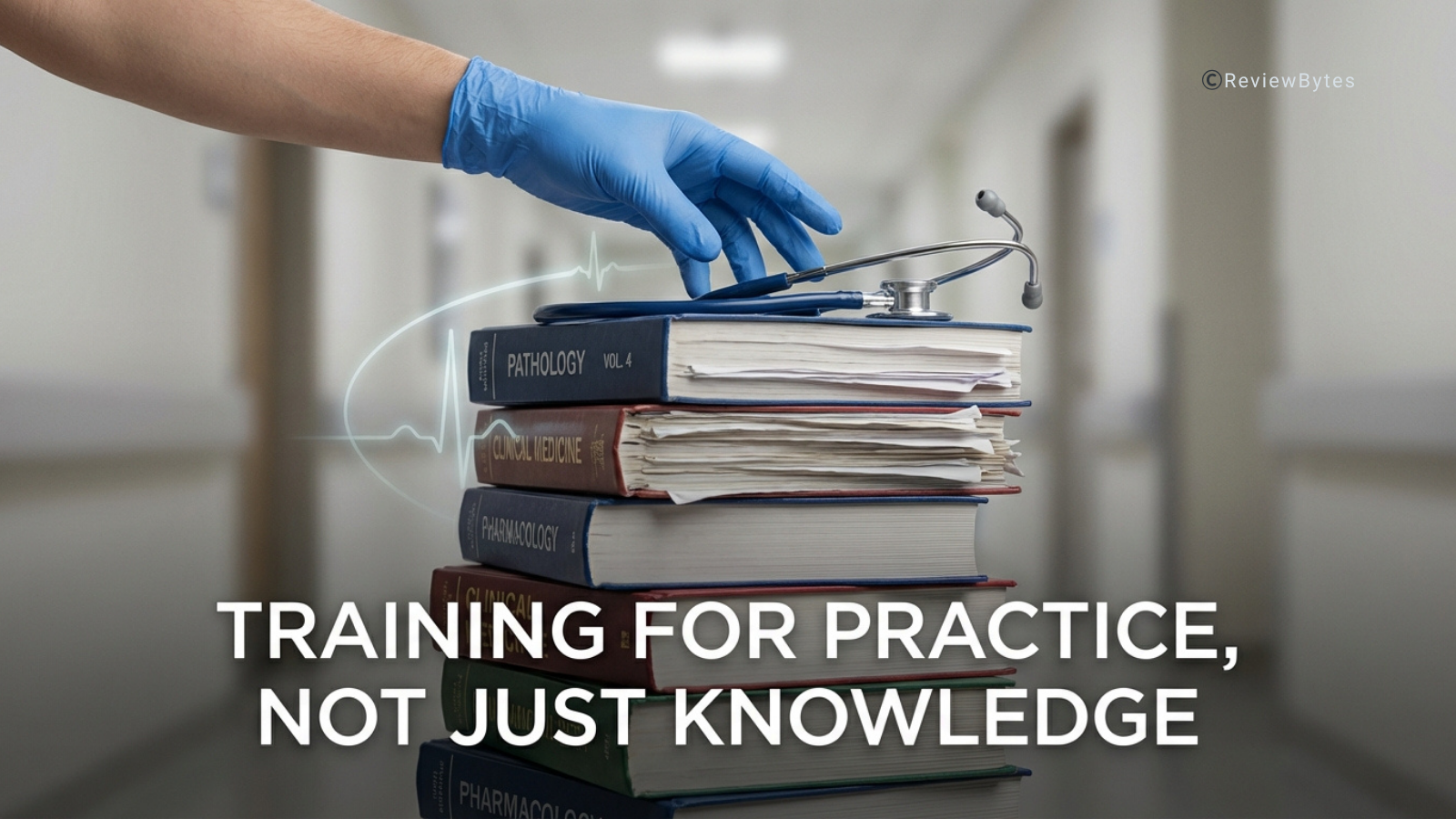
Readiness is a concept in medical education system that treats both high-stakes exams and clinical transitions as measurable readiness problems, not as separate knowledge gaps or logistical hurdles—by building competence, contextual awareness, and self-calibration in tandem.
Most medical education resources approach board exams as knowledge deficits and career transitions as emotional or logistical challenges. But both test the same underlying capability: your readiness to perform when it matters. This article explains what readiness means, why it represents a shift in medical training, and how the Competence × Context × Calibration model offers a better framework for preparing clinicians across every stage of their careers.
Medical education has long treated exams and transitions as if they live in separate universes:
But ask any intern starting July 1st or any attending switching from hospital medicine to cardiology: both situations demand the same thing—readiness to perform under pressure with incomplete information and high stakes.
Readiness is not just knowing facts. It's the integration of:
When all three align, you feel ready. When even one is missing, you feel underprepared—even if you "studied hard."
Research in competency-based medical education confirms this: learners who can self-assess accurately (calibration) and adapt to clinical context outperform those with knowledge alone (PMID: 28598742).
This is the core model that defines a Readiness program.
This is what most traditional resources target:
A Readiness system builds competence efficiently using AI to personalize question spacing, identify weak areas, and focus effort where it matters most.
This is what differentiates a classroom learner from a performing clinician.
Transitions fail not because learners lack knowledge, but because contextual mismatches create cognitive overload and decision fatigue (PMID: 40156179). A third-year med student rotating into surgery doesn't just need to know anatomy—they need to know how this surgery team runs rounds, what the chief resident expects, and how to pre-round efficiently in that hospital's EHR.
Traditional med-ed ignores this. Orientation is often generic ("here's the call room") rather than actionable ("here's how to navigate your first code blue on this unit").
A Readiness system integrates context-aware learning—not just "what's the treatment for hyperkalemia?" but "how do you order it here, who do you notify, and what's the follow-up protocol on this service?"
Calibration = the accuracy of your self-assessment.
Research in medical education shows that most learners are poorly calibrated—they overestimate performance on easy material and underestimate it on hard material (PMID: 18605878).
A Readiness system doesn't just test you—it teaches you how to self-assess, so you know when you're ready to perform and when you need more focused study.
Best evidence: spaced retrieval and active learning
A meta-analysis of health professions education found that spaced practice improved exam scores by 0.5–0.8 standard deviations compared to traditional studying (PMID: 41601436). That's the difference between a passing and high-performing board score.
Cohort studies show:
Key insight: Transitions fail not because trainees aren't smart enough, but because they lack contextual onboarding and calibration feedback (am I doing this right? Who do I ask?).
Physician assistants and nurse practitioners switching specialties (e.g., from internal medicine to hematology/oncology, or primary care to cardiology) face unique readiness gaps:
Attendings switching specialties (e.g., hospitalist to cardiology, or retiring surgeon moving to teaching role) experience similar issues—knowledge is there, but context and role expectations shift, and there's often no formal onboarding (PMID: 32336617).
A Readiness system serves these learners by targeting context and calibration, not just knowledge review.
| Myth | Reality |
| "More study time = better performance." | Effort doesn't equal outcome. Passive re-reading is far less effective than spaced retrieval (PMID: 26173288). Quality and method matter more than hours logged. |
| "Exams test knowledge; transitions test soft skills." | Both test readiness. Exams require calibration (test-taking strategy, time management) and context (exam format). Transitions require competence (clinical reasoning under pressure). |
| "I'll just learn on the job during transitions." | Unstructured learning is inefficient and risky. Without calibration feedback, you may reinforce errors or miss critical knowledge gaps (PMID: 29303739). |
| "AI in education is just ChatGPT for cheating." | AI-native platforms should integrate machine learning to personalize spaced repetition, identify knowledge gaps, and provide real-time calibration feedback—not to replace learning, but to optimize it (PMID: 38423127). |
| "Orientation sessions prepare me for transitions." | Generic orientation ≠ readiness. You need role-specific, context-aware onboarding plus ongoing calibration (check-ins, feedback loops) (PMID: 40156179). |
Use readiness-focused preparation when:
Seek additional support if you experience:
In these cases, readiness tools are helpful but not sufficient—you may need mentorship, wellness resources, remediation, or systems-level change.
How to interpret this table: This compares conventional study methods with the Readiness model across key outcomes and evidence.
| Feature | Traditional Approach | Readiness System | Evidence Note |
| Exams | Knowledge problem → more content, more hours | Readiness problem → competence + calibration + test-taking context | Spaced retrieval + feedback outperforms massed study (PMID: 26173288) |
| Transitions | Emotional/logistical problem → orientation + "you'll figure it out" | Readiness problem → context mapping + role clarity + calibration feedback | Role ambiguity predicts transition difficulty (PMID: 40156179) |
| Study method | Passive (videos, re-reading, highlighting) | Active (spaced retrieval, interleaving, confidence tagging) | Active recall improves retention by ~50% (PMID: 26173288) |
| Personalization | One-size-fits-all curriculum | AI-driven adaptive learning (focuses on your weak areas) | Adaptive learning improves efficiency and outcomes (PMID: 38423127) |
| Feedback | Delayed (end-of-rotation eval, exam score weeks later) | Immediate (after each question, with explanations + patterns) | Immediate feedback improves calibration (PMID: 18605878) |
| Context | Generic (textbook cases, no workflow info) | Context-aware (role-specific, system-specific, team dynamics) | Context mismatch causes cognitive overload (PMID: 40156179) |
| Goal | "Did I pass?" | "Am I ready to perform?" | Readiness predicts real-world performance, not just test scores (PMID: 32804992) |
How to interpret this table: Both use Competence × Context × Calibration, but each emphasizes different components.
| Readiness Type | Competence Focus | Context Focus | Calibration Focus | Example Scenarios |
| Exam Readiness | High (knowledge depth, reasoning speed, pattern recognition) | Moderate (test format, time management, question style) | High (confidence accuracy, knowing when to guess vs. rule out) | Step 1/2/3, ABIM boards, in-training exams, PANCE, PANRE |
| Transition Readiness | Moderate (refresh key concepts, fill new-role knowledge gaps) | High (workflow, systems, role expectations, team dynamics) | High (knowing what you don't know, when to escalate, feedback-seeking) | MS3 → clerkships, intern year, residency → fellowship, hospitalist → cardiology, PA switch from IM to oncology |
Key takeaway: A Readiness system uses the same model for both, so you're not learning two separate systems, you're building a unified skillset that serves you across your entire career.
Readiness systems are powerful, but they don't fix:
A readiness system is a tool, not a panacea. It works best when embedded in a supportive learning and practice environment.
Sometimes, despite doing everything right, you hit a plateau. This may signal:
Readiness systems should include escalation pathways for these situations.
5. Birnbaum MS, Kornell N, Bjork EL, et al. Why interleaving enhances inductive learning: the roles of discrimination and retrieval. Mem Cognit. 2013;41(3):392-402. PMID: 23138567.
A: Traditional question banks focus on competence (knowledge testing), often without calibration feedback (how accurate is your confidence?) or context integration (how does this apply in your specific role/setting?). A Readiness system combines all three—competence-building through evidence-based methods (spaced retrieval, interleaving), calibration training (confidence tagging, pattern recognition), and context mapping (role-specific workflows, transition support). It's not just "did you get the question right?" but "are you ready to perform in this situation?"
A: Both exams and transitions test the same underlying readiness—your ability to perform under pressure with stakes. Exams emphasize competence + calibration (do you know it? can you apply it under time pressure?). Transitions emphasize context + calibration (do you know the workflow? can you assess what you don't know and ask for help?). Readiness = Competence × Context × Calibration model covers both, and research shows that self-regulated learning, feedback, and context-awareness improve performance in both domains (PMID: 22150198, PMID: 40156179).
A: Anki is excellent for spaced repetition of competence (knowledge), but it doesn't address calibration (you don't track confidence accuracy over time) or context (it's not role- or transition-specific). A Readiness Platform adds those layers: AI-driven identification of your weak areas (not just card frequency), confidence calibration tracking, and transition-specific content (e.g., "you're switching to cardiology—here's what workflow changes to expect and what knowledge gaps to fill").
A: CME courses provide knowledge (competence) but often don't help with context (how does this oncology practice run? what are role expectations? how do I navigate chemo approval processes?) or calibration (am I ready to manage neutropenic fever independently, or should I escalate?). A Readiness Platform integrates all three, offering not just content but transition-specific onboarding plus feedback loops to assess your readiness in real time.
A: Track your confidence vs. accuracy. After each practice question or clinical decision, rate your confidence (high/medium/low). Then check: were you right? Over time, well-calibrated learners are confident when correct and uncertain when incorrect. Poorly calibrated learners are overconfident in wrong answers or underconfident on correct ones. Readiness platforms make this visible through dashboards and feedback (PMID: 18605878).
A: Individual learners can still apply readiness principles: use spaced practice (not cramming), test yourself actively (not passive re-reading), seek immediate feedback, and map context deliberately (ask: what's different about this rotation/role? what do I need to know about workflows, team expectations, and supports?). A formal platform makes it easier, but the principles are evidence-based and actionable on your own.
A: The readiness model is explicitly designed for time-limited, high-stakes situations—it's built for people who don't have time. The goal is efficiency: learning science shows that spaced retrieval and interleaving take less total time than massed study or passive review while producing better outcomes (PMID: 26173288, PMID: 41601436). The AI-native design focuses effort where you're weak, not wasting time on what you already know.
A: No. Readiness platforms are tools, not substitutes for human guidance. They help you build competence efficiently, map context systematically, and calibrate accurately—but you still need mentors for nuanced judgment, real-time clinical decision support, and professional development. Think of it as optimizing the 80% of learnable, measurable readiness so you can use mentorship time for the 20% that requires expert human insight.
A: Plateaus signal you may need additional support—advanced coaching (if it's a test-taking or strategy issue), content remediation (if there's a foundational gap), or assessment for learning differences. Readiness platforms should include escalation pathways for these situations. Also consider burnout screening if effort feels futile—that's a wellness issue, not just a study issue (PMID: 30418984).
A: Readiness applies across the career arc. Attendings switching specialties, taking on new administrative roles, or moving to new practice settings face transition readiness challenges—context changes (new workflows, new team culture) and calibration challenges (overconfidence in old role, under confidence in new one). The four-stage model (Prepare → Perform → Recover → Advance) applies whether you're an intern or a 20-year attending shifting roles.
Disclaimer: This article is for educational purposes only and does not constitute personalized medical, educational, or career advice. Individual learning needs, transition challenges, and exam preparation strategies vary. Consult with mentors, program directors, and educational specialists for guidance tailored to your specific situation. If you're experiencing burnout, depression, or safety concerns, seek appropriate clinical and institutional support.