Why Clinicians Need a New Way to Study in the Age of AI. Introducing ReviewBytes
Read more

Master the Readiness Continuum: the 3-phase framework every MD, PA, NP, and resident needs. Close the gap between training, transition, and practice.

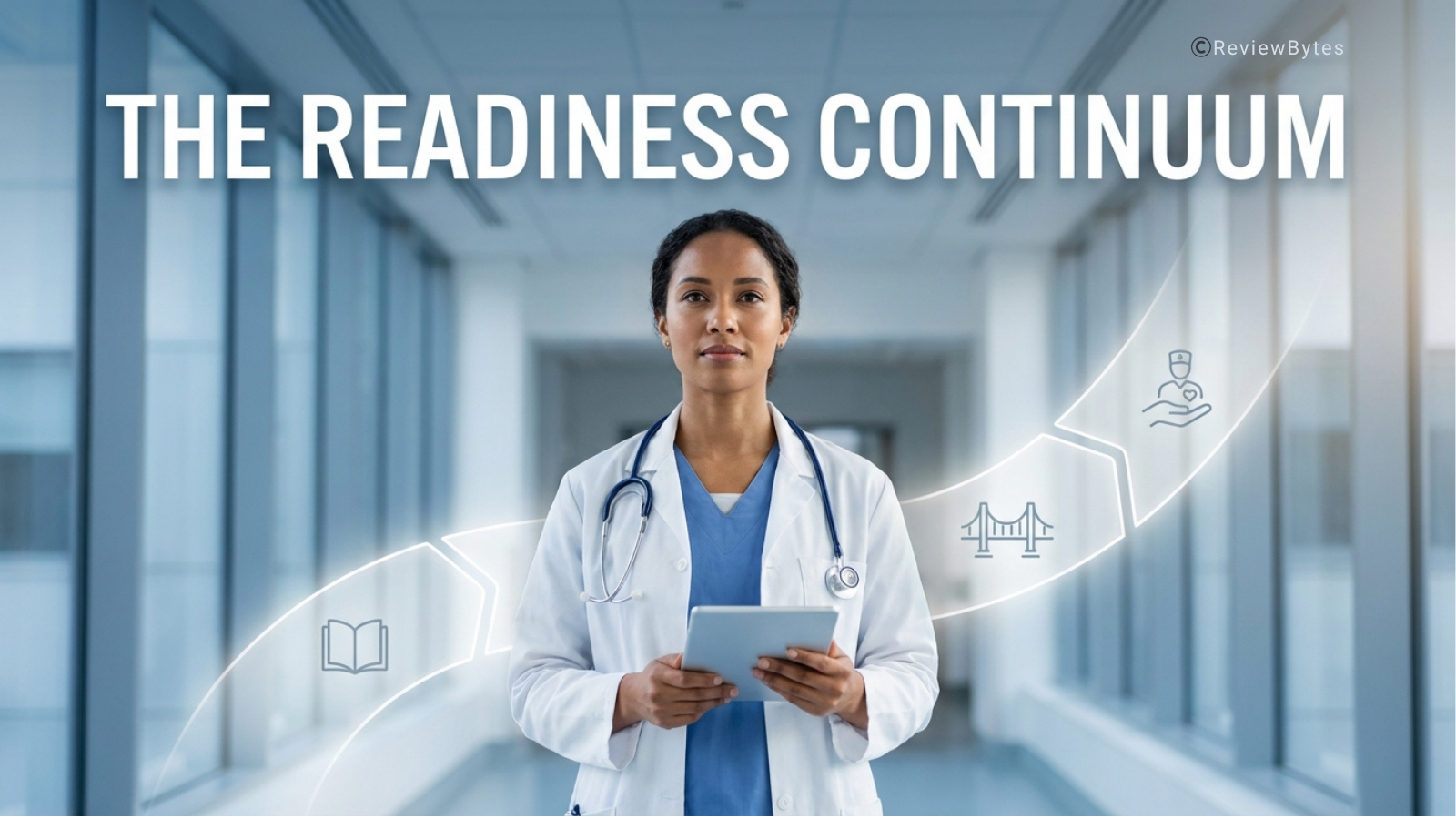
The Readiness Continuum is the three-phase framework that explains why strong performance in training alone does not guarantee success at licensing boards, high-stakes role transitions, or independent practice—and it gives every clinician, resident, PA, and NP a concrete, evidence-aligned roadmap for what readiness actually requires at each stage of their career.
Most training programs do their jobs well. They build knowledge, instill clinical reasoning, and shape professional identity. But few programs explicitly address the gaps between phases—the fault lines where capable, hardworking trainees become unexpectedly unprepared clinicians. This article maps those fault lines, names the cognitive mechanisms behind them, and shows you how to cross each one with confidence.
Readiness, in the clinical training context, is not a score or a single skill threshold. It is a dynamic state of preparedness—cognitive, procedural, emotional, and contextual—that must be deliberately rebuilt every time a clinician moves to the next phase of their career.
This concept builds directly on the Competence × Context × Calibration model of readiness, which explains how these three elements must align for a clinician to perform when stakes are high. While that framework defines what readiness is, the Readiness Continuum now maps when and how it must be rebuilt across a career.
| Readiness Type | Definition | Most Critical Phase |
| Declarative | Factual and conceptual knowledge ("what") | Training |
| Procedural | Skill execution and clinical application ("how") | Training → Transition |
| Contextual judgment | Clinical reasoning in real, complex conditions ("when/why") | Transition → Practice |
| Metacognitive | Accurately knowing the boundaries of what you know | All three phases |
This framework aligns directly with competency-based medical education (CBME), which anchors readiness to demonstrable outcomes rather than time served in a program (PMID: 20662574).
Readiness gaps are not failures of intelligence or effort. They are structural failures of preparation architecture, driven by three well-documented mechanisms in the cognitive and educational psychology literature.
Medical training requires simultaneously processing thousands of clinical facts, drug interactions, pathophysiology pathways, and procedural sequences. When working memory is saturated, long-term encoding collapses—material studied once is not reliably retrievable under exam or clinical pressure.
Cognitive load theory explains why passive review of dense board review books or back-to-back lecture recordings rarely produces durable, board-ready knowledge (PMID: 20078759).
Knowledge acquired in structured lectures or PBL sessions often fails to transfer to exam rooms or clinical floors. This "transfer gap" explains why learners who genuinely understand the material still underperform on standardized assessments—the retrieval context is simply unfamiliar (PMID: 26173288).
Moving from one clinical identity to the next is psychologically demanding. Research consistently shows:
Medical, PA, and NP training programs do many things well. They deliver foundational sciences, build pattern recognition through supervised encounters, and develop professional identity over years of immersive learning. But preparation architecture is consistently the missing piece.
Research on USMLE performance consistently shows that curriculum coverage accounts for only a portion of score variance. Dedicated preparation method and self-testing frequency are stronger predictors of outcome than preclinical course grades (PMID: 29065026).
This is where the continuum becomes most consequential—and where most clinicians feel most alone.
These are not knowledge pop quizzes. They are structured assessments of readiness for independent clinical practice:
Most transition-phase candidates are simultaneously managing:
Time compression is the structural barrier. Evidence shows an inverse relationship between perceived preparedness and proximity to exam date, independent of actual knowledge level—meaning most candidates feel less ready the closer they get, regardless of what they actually know (PMID: 37251203).
Five strategies hold the strongest, most consistent evidence base:
Passing your boards is the beginning of a new chapter on the Readiness Continuum—not the conclusion.
When newly licensed clinicians transition into independent or near-independent roles, a measurable performance dip occurs:
This is not a competence indictment. It is a systems failure to provide adequate readiness support at the most vulnerable point on the continuum. Graduated autonomy, structured onboarding, and continuation of active learning during this phase are evidence-supported patient safety interventions (PMID: 21747093).
| Myth | What the Evidence Actually Shows | Supporting PMID |
| "Knowing the material = passing boards" | Exam format fluency, pacing, and test strategy matter equally to content mastery | PMID: 29065026 |
| "Cramming the week before is efficient prep" | Massed studying produces rapid knowledge decay; spaced repetition produces durable retrieval | PMID: 18276894 |
| "Feeling anxious means I'm not ready" | Moderate anxiety is normal and may facilitate performance; only pathological anxiety impairs outcomes | PMID: 24448053 |
| "New graduates are practice-ready at licensure" | July effect data demonstrates measurable transition-phase clinical risk across multiple national datasets | PMID: 21747093 |
| "Re-reading is the most thorough way to prepare" | Re-reading ranks among the least effective study strategies in every major evidence synthesis | PMID: 26173288 |
| "MOC is bureaucratic box-checking" | MOC participation correlates with knowledge currency and, in some analyses, patient-level outcomes | PMID: 25490325 |
How to interpret Table A: Match your current position on the Readiness Continuum to the preparation approach with the strongest supporting evidence. The "Avoid" column reflects strategies with consistently low evidence efficacy.
| Phase | Primary Barrier | Highest-Yield Strategy | Avoid | Evidence PMID |
| M1–M2 Pre-clinical Training | Volume overload; passive habits | Spaced repetition + concept mapping | Re-reading; passive highlighting | PMID: 26173288 |
| M3–M4 Clinical Rotations | Transfer gap; theory-to-practice failure | Case-based MCQ + clinical vignettes | Memorization without clinical context | PMID: 29065026 |
| Board / Licensing Exam Transition | Time compression + learning anxiety | Microlearning + interleaved MCQ blocks | Cramming; passive video-only review | PMID: 18276894 |
| Role Transition (new title/setting) | Confidence-competence mismatch | Simulation + graduated autonomy + feedback | Unsupported independent entry | PMID: 21747093 |
| Early Practice (Years 1–2) | Protocol unfamiliarity; knowledge gaps | Onboarding curricula + point-of-care tools | Assuming boards = full practice readiness | PMID: 25490325 |
| Sustained Practice | Guideline drift; knowledge decay | MOC programs + microlearning | Skipping or delaying recertification | PMID: 25490325 |
How to interpret Table B: Identify your clinician type, the key high-stakes transition ahead, and the intervention most supported by the evidence for your situation.
| Clinician Type | Key Transition | Primary Readiness Barrier | Best-Fit Intervention | Evidence PMID |
| Medical Student (M1–M2) | USMLE Step 1 | Content volume + retention failure | Spaced repetition + Qbank practice | PMID: 18276894 |
| Medical Student (M3–M4) | USMLE Step 2 CK | Clinical reasoning transfer gap | Vignette MCQ + case-based review | PMID: 29065026 |
| PGY-1 / Intern | ITE + new intern role | Overload + acute confidence gap | Microlearning + structured mentorship | PMID: 21747093 |
| Senior Resident | ABIM / ABFM Initial Certification | Time scarcity + exam fatigue | Timed Q-banks + spaced recall | PMID: 18276894 |
| Physician Assistant | PANCE / PANRE | Content breadth + re-entry knowledge gaps | Structured review + focused MCQ blocks | PMID: 26173288 |
| Nurse Practitioner | ANCC / AANPCB Boards | New role + clinical confidence deficit | Role-specific MCQ + simulation | PMID: 24448053 |
| Early Attending / New NP or PA | MOC + institutional onboarding | Knowledge decay + protocol unfamiliarity | Point-of-care learning + MOC programs | PMID: 25490325 |
The Readiness Continuum is not always a straight line. These situations require genuinely individualized preparation approaches:
Traditional study resources—comprehensive textbooks, marathon review lectures, generic question banks—were designed for a learning environment that most busy residents, PAs, NPs, and early-career physicians no longer inhabit. Today's readiness challenges demand something architecturally different: tools designed around how clinicians actually learn under pressure, not around how curricula are organized.
Platforms such as ReviewBytes fill this unique gap by targeting readiness preparation specifically for high-risk exams and high-stakes clinical transitions. Rather than piling more content onto an already overwhelmed learner, ReviewBytes layers microlearning techniques—concise, targeted, high-yield learning episodes—directly alongside traditional board-style MCQs engineered to replicate the cognitive demand and exact format of licensing and certification examinations. This dual-format approach directly combats the most common and well-documented barriers to readiness preparation: the information overload that accompanies voluminous testable material, the severe time deficiency endemic to clinical training and working-clinician schedules, the learning anxiety that compounds when preparation feels unmanageable, and the challenge of building fluency with genuinely new or unfamiliar content under real exam-condition pressure. By meeting clinicians at every point along the continuum—from early board prep through high-stakes role transitions to practice-phase upskilling—platforms like ReviewBytes close the structural preparation gap that even thoughtfully designed training programs inevitably leave behind.
The Readiness Continuum is a three-phase framework—training, transition, and practice—that describes how clinicians must actively rebuild their readiness at each career stage. Strong performance in one phase does not automatically transfer to the next; each phase demands a qualitatively different type of preparation.
Medical and advanced practice training is designed to build clinical competence—not specifically exam performance. Licensing exams (USMLE, ABIM, PANCE, ANCC) require specific test-taking skills, format familiarity, and strategic retrieval under time pressure that passive training programs don't explicitly develop.
The evidence clearly supports spaced repetition, active recall (retrieval practice), board-style MCQ practice, and interleaved studying across topics and systems. Passive strategies—re-reading, passive highlighting, and marathon video watching—consistently rank lowest in every major comparative evidence review.
The "July effect" refers to documented increases in medication errors and adverse outcomes when newly trained clinicians transition into independent or near-independent roles at the start of the U.S. academic year. It provides strong evidence that transition risk is real and quantifiable—making structured readiness preparation a patient safety issue, not just a career one.
Not entirely. Board certification verifies minimum knowledge standards—but not contextual judgment, institutional familiarity, or the procedural fluency that comes from experience in a specific setting. Phase 3 of the Readiness Continuum—onboarding, MOC, and continued upskilling—is where that gap gets closed.
PAs and NPs navigate the same three-phase continuum—from rigorous program-based training through high-stakes licensing (PANCE for PAs; ANCC or AANPCB for NPs) to collaborative or independent clinical practice. Scope-of-practice expansions and subspecialty transitions represent additional high-stakes inflection points on their specific continuum path.
Microlearning uses short, focused learning episodes (typically 5–15 minutes) targeting specific high-yield content units. It reduces cognitive overload, fits into the compressed and fragmented schedules of working clinicians, and preserves motivation under exam-period stress—making it especially well-matched to the transition phase of the Readiness Continuum.
Yes. Moderate anxiety is physiologically normal and may even facilitate performance by increasing focus and retrieval effort. Pathological anxiety—the kind that impairs daily function—typically signals a preparation architecture problem (insufficient structured practice, poor pacing, inadequate self-assessment feedback) rather than a true knowledge deficit. Structured preparation with clear milestones and confidence-building practice questions consistently reduces anxiety over a preparation cycle.
⚠️ Disclaimer: This article is intended for educational purposes only and does not constitute personalized medical, career, or examination advice. Readiness and preparation needs vary substantially by specialty, jurisdiction, individual learning profile, and exam cycle. Consult your program director, relevant credentialing board, or a qualified educational specialist for guidance specific to your situation.